Alexandre Bak - Classical Music Reference Recording

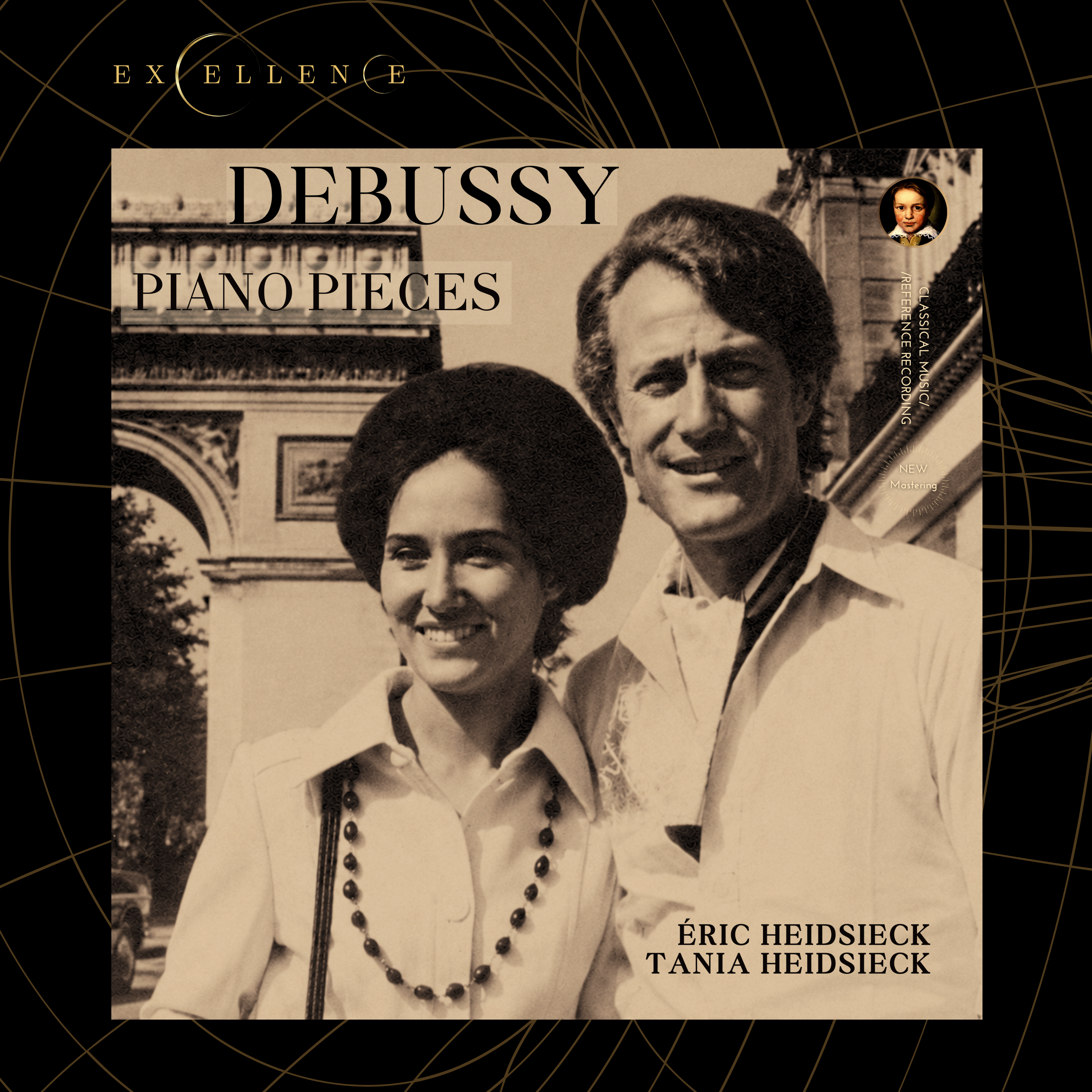
Debussy: Piano Pieces by Éric and Tania Heidsieck (2026 Remastered, Paris 1999)

Skip to product information
1 of 6
Support
Regular price €30,00 EUR
Regular price Sale price €30,00 EUR
Sale Sold out
Taxes included.

WAV Stereo 24-Bit/176.4 kHz

View full details

Product details

Editorial reviews

Debussy: Piano Pieces

Éric and Tania Heidsieck (2026 Remastered, Paris 1999)

1 disc(s) - 11 track(s)
Total length: 00:54:48


The Performer’s Perspective. Érick Heidsieck:

L’Isle joyeuse. With its subtle exoticism, this piece is the musical counterpart of L’Embarquement pour Cythère. Everything invites us on a journey of love: the swell of the waves cradling an exciting melody and the song of the sirens, who beguile the sailor with their voluptuous calls.

Pour le piano (1901). Prélude: A first theme in A minor creeps along in the low register, sinuous and unsettling, but gradually brightens as it rises towards the upper register, leading into the second theme in C major, a series of dancing chords splashed with the dazzling light of glissandos. Having reached its summit, the final chord falls back in a shower of cascading notes. The first theme then returns. After the recapitulation, the Prélude concludes with a recitative in which Debussy delights in contrasting, through a series of scales, the B mode and the whole-tone scale, whose colourful palette opens and closes before our astonished eyes.

Sarabande: A slow dance of elegantly solemn gestures, the Sarabande reveals, at the heart of the piece, an emotion that has hitherto remained beneath the surface. The slightly hurried pace of the clusters of chords briefly betrays this emotion. Then the theme returns, hieratic and solemn.

Toccata: Flowing naturally from the Sarabande in C-sharp minor, the Toccata follows seamlessly in the same key. We know of Debussy’s aversion to hammers and to the percussive nature of our instrument! We should therefore not be surprised to find a horizontal style of writing, an elusive legato and considerable lyricism in the second theme in C major, rather than the staccato usually associated with this musical form.

Hommage à Rameau. This masterpiece delves even deeper into the feelings expressed in the Sarabande. At the heart of the work, two deeply moving, impassioned cries resound. To whom are these cries of distress rising, calling upon the great French dramatist of the eighteenth century as their witness?

Estampes. At the 1889 Exposition Universelle, Debussy had been captivated by the sounds of the gamelan, an orchestra from Indonesia composed mainly of bronze instruments, such as gongs and xylophones. From this profound impression would emerge, a few years later, the inspired evocation of Pagodes.

Soirée dans Grenade: Likewise, despite never having crossed the Pyrenees, Debussy instinctively captures the amorous melodies and hypnotic rhythms of Andalusian nights.

Jardins sous la pluie: In Jardins sous la pluie, Claude de France paints for us, beneath the Parisian groves, a children’s round dance that momentarily drives away the first autumn storm.

Le Petit Nègre. An amusing little musical sketch! One takes delight in watching the child strolling along with a gait that is at once carefree and nonchalant. Twice, he will interrupt his carefree journey to indulge in a moment of reverie.

Enjoy your listening

Track listing

I. L’Isle Joyeuse, L. 106: Quasi una cadenza (2026 Remastered, Paris 1999)
II. Pour le Piano, L. 95: I. Prelude: Assez animé et très rythmé (2026 Remastered, Paris 1999)
III. Pour le Piano, L. 95: II. Sarabande: Avec un élégance grave et lente (2026 Remastered, Paris 1999)
IV. Pour le Piano, L. 95: III. Toccata: Vif (2026 Remastered, Paris 1999)
V. Images, Book 1, L. 110: II. Hommage à Rameau: Lent et grave (2026 Remastered, Paris 1999)
VI. Estampes, L. 100: I. Pagodes: Modérément animé (2026 Remastered, Paris 1999)
VII. Estampes, L. 100: II. La soirée dans Grenade: Mouvement de Habanera (2026 Remastered, Paris 1999)
VIII. Estampes, L. 100: III. Jardins sous la pluie: Net et vif (2026 Remastered, Paris 1999)
IX. Le Petit Nègre, L. 114: Allegro giusto (2026 Remastered, Paris 1999)
X. Nocturnes, L. 91 (Transcription pour 2 pianos): I. Nuages: Modéré (2026 Remastered, Paris 1999)
XI. Nocturnes, L. 91 (Transcription pour 2 pianos): I. Fêtes: Animé et très rythmé (2026 Remastered, Paris 1999)