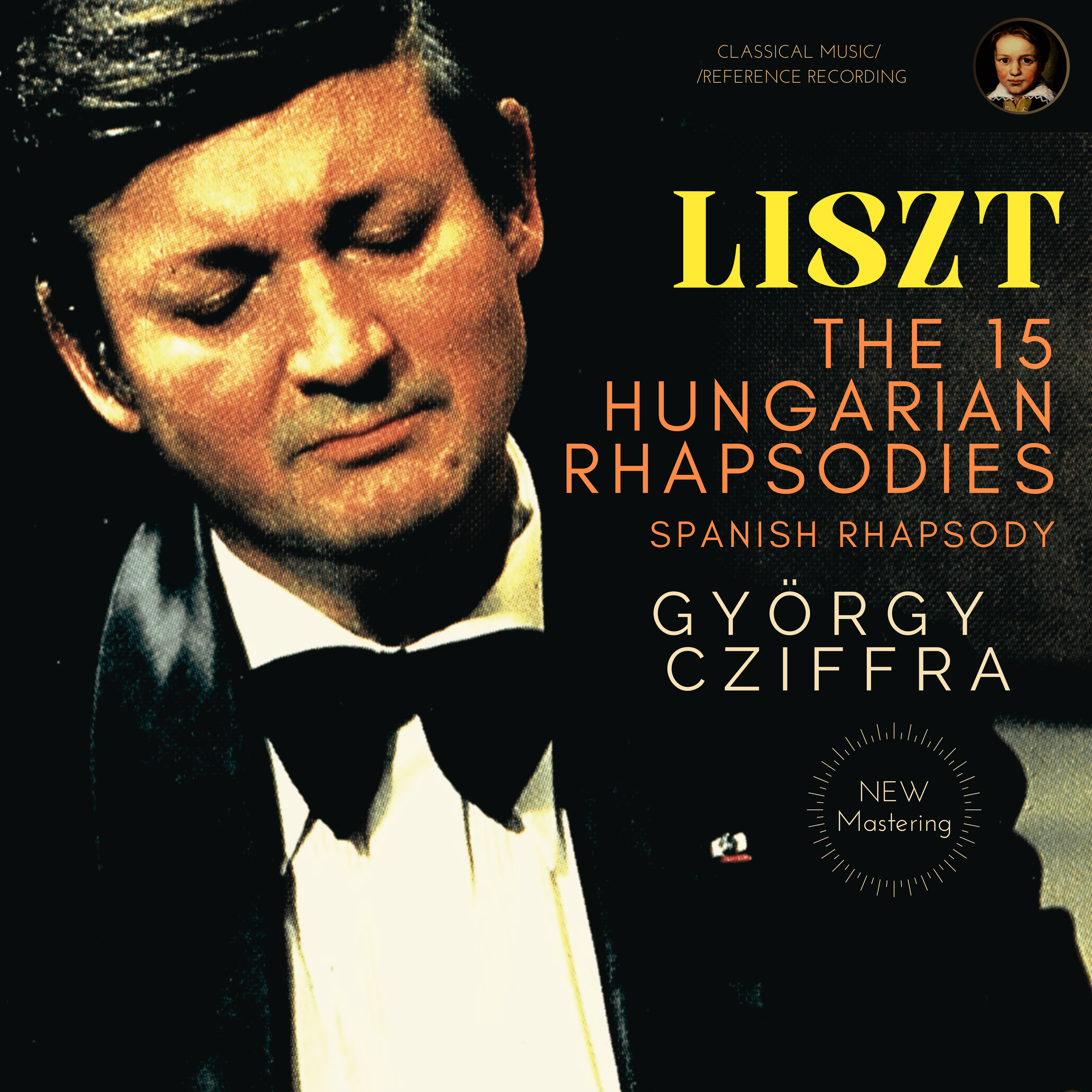
Liszt: The 15 Hungarian Rhapsodies, Spanish Rhapsody
Gyorgy Cziffra (2020 Remastered, Paris 1957-58)
2 disc(s) - 16 track(s)
Total length: 02:10:26
The first recording of the Hungarian Rhapsodies by György Cziffra dates from the late 1950s. It possesses an infinite poetry, placing greater emphasis on the lyrical dimension of the Rhapsodies. The second recording (1974) is more nervous and forceful in its attacks, highlighting more strongly the technical and rhythmic aspects. In every respect, Cziffra’s recordings — the great champion of the Rhapsodies — are essential listening for anyone interested in Liszt or, more broadly, in music itself.
Franz Liszt — Hungarian Rhapsodies. On December 21, 1839, Liszt arrived in Pest: he was welcomed there as a hero, and the concerts he gave in January of the following year sparked extraordinary enthusiasm. Through the sheer force of his talent, the artist had succeeded in stirring the national spirit, notably during his unrestrained improvisation on the theme of the Rakoczi March. Was his elevation to the dignity of “honorary citizen” of the city of Pest a sign of his definitive “Hungarianization”? A born observer and bearer of remarkable intuition, Liszt had nevertheless taken care to absorb what he believed to be the profound song of Hungary, but which in reality consisted only of Gypsy approximations. During his next journey, in 1846, he sensed the full aesthetic potential he could draw from this seductive and capricious music. The idea of the Hungarian Rhapsodies was born, along with that exaltation of folk melody that would later bring fortune to Brahms, Dvořák, and the Russian composers of the second half of the nineteenth century.
Although the rhapsodic idea had been germinating in Liszt’s mind since 1838, nourished by the composition of Hungarian melodies after Schubert, the first works only emerged from 1847 onward — representing a rather significant period of maturation. Liszt had taken as models those folk melodies masterfully performed by the man nicknamed the “Rossini of the violin,” János Bihari, and which, contrary to popular belief, were not Gypsy in origin. Liszt made no attempt to conceal this influence, as evidenced by this statement to his friend Gabriel Mátray, director of the Budapest Conservatory of Music:
“During my stay in Hungary and Transylvania, Hungarian melodies became, so to speak, the very blood of my soul. Whenever several orchestras performed them before me, I delighted in them. How often have I intoxicated myself with them! They plunged me into wonderment. That admirable and magnificent kaleidoscope: sadness, sorrow, suffering, depth of spirit, pathos, grace, reverie, gravity, playfulness, melancholy, boredom — everything passes before one’s eyes. It is also my duty to express the intimate, powerful, free, rich, and exalted poetry of our national music. Have I done so satisfactorily? The proof will be my work of several years, which shall appear in a series of volumes under the title: Hungarian Rhapsodies, in four books, each comprising 10–15 pages…”
By adopting the scheme of two alternating dances and expanding it with an introduction and a conclusion, Liszt developed a coherent and varied form — supple and unconstrained — within which he could fully unleash his imagination. Yet, reading the preface to these collections, one notices that he pushed his ambition beyond mere form:
“By the word ‘rhapsody,’ we wished to designate the fantastically epic element we believed we recognized therein. Each of these works has always seemed to us to belong to a poetic cycle, remarkable for the unity of its inspiration, eminently national in the sense that it belongs to one people alone and perfectly paints its soul and innermost feelings, nowhere else expressed so clearly in a form equally proper to that people, invented and practiced by them… Furthermore, we called them Hungarian Rhapsodies because it would not have been right to separate in the future what had not been separated in the past. The Magyars adopted the Gypsies as their national musicians.”
Numbering around twenty works, the Hungarian Rhapsodies, beyond their musical substance, constitute the ideal field of application for the pianistic technique invented and perfected by Liszt. At no moment do the many dazzling digital feats appear foreign to the discourse: virtuosity becomes a form of play comparable to that practiced by the Gypsy musicians Liszt had heard in Hungary.
Enjoy your listening


 ALSO AVAILABLE ON STREAMING PLATFORMS